Why Is Exercise Good For Mental Health?

Life gets heavy sometimes.
Between work, parenting, relationships, stress, finances, and everything else pulling at your attention, it’s easy to feel mentally exhausted. And when your mental health starts struggling, exercise is often the very last thing you feel like doing.
But here’s what we’ve seen over and over again at Peak Physique:
Movement changes people.
Not just physically, mentally too.
If you’ve been wondering why is exercise good for mental health, the answer goes much deeper than simply “working out makes you feel good.” Exercise affects your brain chemistry, stress response, sleep, confidence, energy, and even your resilience during difficult seasons of life.
And the best part? You don’t need extreme workouts to experience the benefits.
Let’s break down exactly how exercise supports mental health and why movement can become one of the most powerful tools in your self-care routine.
Key Takeaways
Exercise helps improve mood by releasing endorphins, serotonin, and dopamine
Regular movement lowers stress hormones like cortisol
Exercise can reduce symptoms of anxiety, depression, stress, and burnout
Movement improves sleep, focus, confidence, and emotional resilience
You don’t need intense workouts to experience mental health benefits
Consistency matters more than perfection
Strength training, walking, yoga, and cardio can all support mental wellness
Personal training provides accountability, structure, and support during difficult seasons
What Is The Connection Between Exercise And Mental Health?
The connection between exercise and mental health is both physical and psychological.
When you move your body, your brain responds almost immediately. Exercise increases circulation to the brain, stimulates the release of mood-regulating chemicals, lowers stress hormones, and activates brain regions associated with emotional regulation and focus.
At the same time, exercise also helps mentally by:
Giving you structure and routine
Creating a sense of accomplishment
Improving self-confidence
Providing healthy stress relief
Helping you feel more in control
That’s why movement often helps people feel calmer, clearer, and more emotionally balanced after a workout, even if they didn’t feel motivated beforehand.
At Peak Physique, we truly believe movement is medicine. Not because exercise “fixes” everything, but because it helps support both your mind and body in ways most people underestimate.
Why Is Exercise Good For Mental Health?
There isn’t just one reason exercise helps mental health. There are many.
Let’s break down some of the biggest ones.
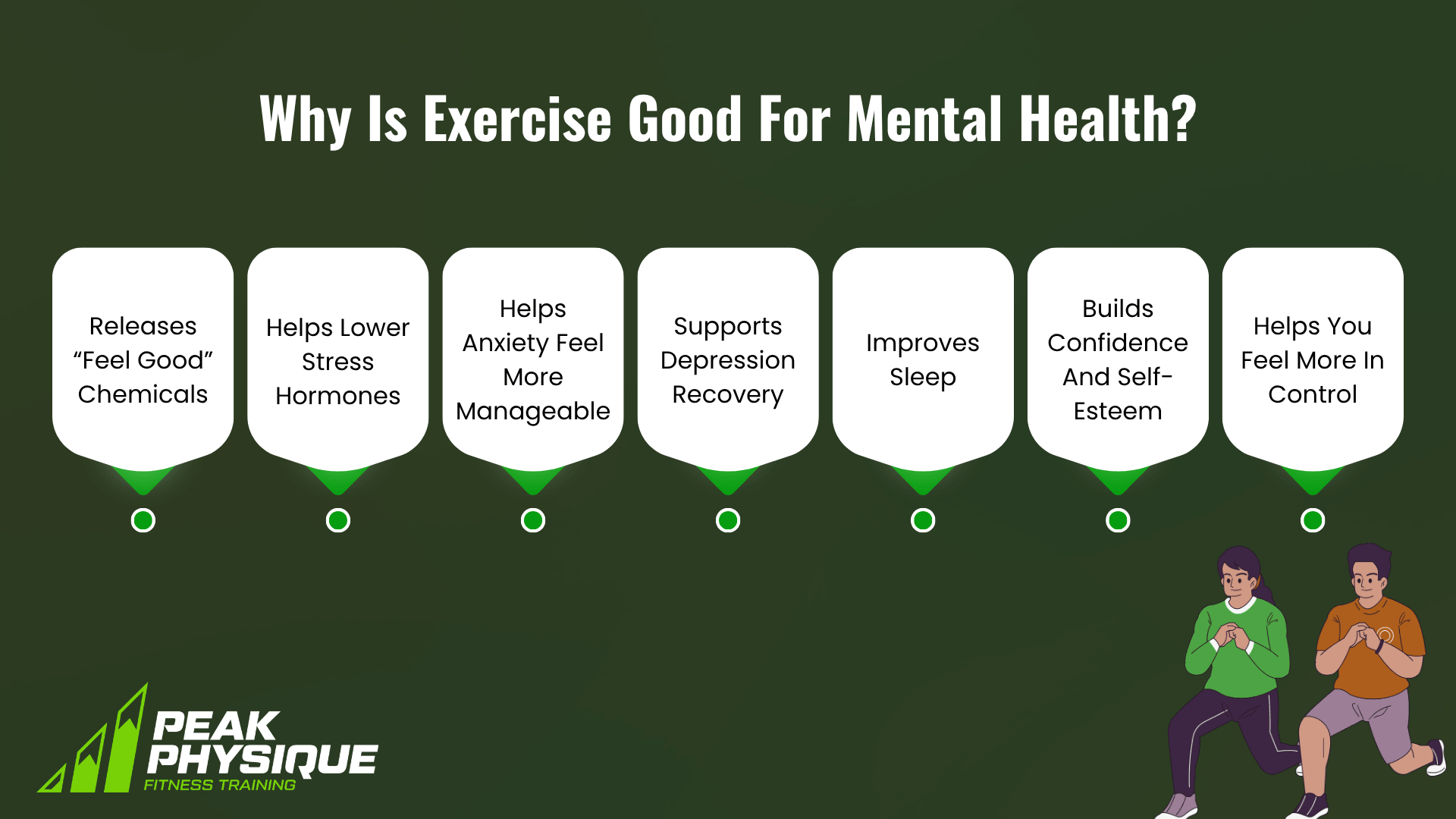
Exercise Releases “Feel Good” Chemicals
One of the biggest reasons exercise supports mental health is that it changes your brain chemistry.
When you exercise, your body releases endorphins, dopamine, and serotonin. These chemicals help improve mood, reduce stress, and increase feelings of calm and motivation.
This is why even a short walk can sometimes completely shift your mindset after a stressful day.
You’ve probably heard of the “runner’s high,” but you don’t need to run marathons to experience these benefits. Strength training, walking, cycling, swimming, stretching, and even dancing can all create positive mental shifts.
Exercise Helps Lower Stress Hormones
Stress doesn’t just live in your mind. It lives in your body too.
When stress builds up, your body releases cortisol and adrenaline. In small doses, those hormones are helpful. But chronic stress keeps your nervous system constantly activated.
That’s where exercise helps.
Movement acts almost like a reset button for your nervous system. It helps regulate cortisol levels and teaches your body how to return to a calmer state more effectively.
This is one reason people often feel mentally lighter after a workout, even if their life circumstances haven’t changed.
Exercise Helps Anxiety Feel More Manageable
Anxiety often creates both mental and physical symptoms.
You may notice:
Racing thoughts
Tight muscles
Shallow breathing
Increased heart rate
Difficulty focusing
Restlessness
Exercise helps interrupt that cycle.
Movement gives your brain something productive to focus on while also helping release physical tension stored in the body. Activities like walking, strength training, yoga, and cycling can help calm the nervous system and reduce anxious energy.
Many people also notice that exercise creates a temporary “mental break” from constant worry and overthinking.
Exercise Supports Depression Recovery
Depression can make even simple tasks feel exhausting.
And when you’re struggling mentally, exercise can feel impossible to start. But research consistently shows that movement can play a powerful role in supporting depression recovery.
Exercise may help by:
Increasing mood-regulating neurotransmitters
Improving sleep quality
Increasing energy levels
Reducing isolation
Creating routine and structure
Building confidence through small wins
Exercise Improves Sleep
Mental health and sleep are deeply connected.
Stress, anxiety, and depression often disrupt sleep patterns, making it harder to fall asleep, stay asleep, or feel rested. Unfortunately, poor sleep then worsens mental health symptoms, creating a frustrating cycle.
Exercise helps regulate your sleep-wake cycle naturally.
People who exercise regularly often experience:
Better sleep quality
Faster sleep onset
More restorative sleep
Improved daytime energy
Exercise Builds Confidence And Self-Esteem
Mental health isn’t just about reducing stress or anxiety. It’s also about how you feel about yourself.
One of the most overlooked benefits of exercise is confidence. Every workout creates proof that you can show up for yourself, and every small improvement builds momentum.
Over time, exercise helps people feel:
More capable
More resilient
More confident
More connected to their body
At Peak Physique, we see this transformation constantly. Clients come in wanting physical changes, but what they often gain most is confidence in themselves again.
Exercise Helps You Feel More In Control
One reason exercise is so powerful for mental health is that it creates stability during stressful seasons.
When life feels chaotic, movement gives you something consistent.
It becomes a healthy outlet that helps you create a routine and space to focus on yourself for a little while.
Even if the workout itself is simple, showing up consistently helps create emotional momentum that carries into other areas of life.
What Are The Mental Health Benefits Of Strength Training?
Cardio often gets most of the attention when discussing mental health, but strength training offers major benefits too.
Strength training can help:
Improve self-esteem
Reduce anxiety symptoms
Increase resilience
Improve focus
Support emotional regulation
Build confidence through progress tracking
There’s also something incredibly empowering about physically feeling yourself get stronger over time. And no, you don’t need to become a bodybuilder to experience those benefits.

Does Outdoor Exercise Help Mental Health More?
In many cases, yes, it really does. Research shows outdoor movement may amplify mental health benefits even further.
Being outside can help:
Reduce stress
Improve mood
Increase feelings of energy
Reduce mental fatigue
Improve focus
Even something as simple as walking outside, hiking, gardening, or stretching in fresh air can positively impact your mental state. This is one reason we often encourage clients to move outdoors whenever possible.
How Much Exercise Do You Need For Mental Health Benefits?
Probably less than you think.
You don’t need two-hour workouts or intense training programs to support your mental health. In fact, moderate, consistent movement tends to work best for most people.
General recommendations suggest:
Around 150 minutes of moderate exercise per week
Or about 20–30 minutes most days
The truth is that you should start wherever you are. If all you can manage is a quick, ten-minute walk or doing some light stretching before bed, it’s better than nothing and can help.
What Types Of Exercise Are Best For Mental Health?
The best exercise is the one you’ll actually stick with. It’s as easy as that.
That said, different types of movement support mental health in different ways.
Walking
Walking is one of the most underrated forms of exercise for mental wellness.
It’s low-pressure, accessible, and incredibly effective for reducing stress and clearing your mind.
Strength Training
Strength training builds both physical and mental resilience. It improves confidence, energy, and focus while helping you feel stronger in daily life.
Yoga And Stretching
Mind-body movement helps regulate breathing, reduce tension, and calm the nervous system.
Cardio
Running, cycling, swimming, and other aerobic activities help release endorphins and reduce anxiety symptoms.
Group Or Shared Training
Community matters for mental health, too.
Exercising around supportive people helps reduce isolation and builds accountability.
That’s one reason our shared personal training sessions at Peak Physique are so powerful.
Why Consistency Matters More Than Intensity
One of the biggest mistakes people make is thinking they need to completely overhaul their life overnight.
That usually leads to burnout.
Mental health benefits come from consistency, not punishment, and we never want you to “destroy” yourself in the gym.
What If I Don’t Feel Motivated To Exercise?
That’s 100% completely normal. Even as personal trainers, there are days we don’t feel motivated to exercise!
Especially when stress, anxiety, burnout, or depression are involved.
Motivation usually comes after action, not before it.
A few things that help:
Start ridiculously small
Focus on movement, not perfection
Choose activities you enjoy
Exercise with another person
Schedule workouts ahead of time
Work with a personal trainer here in Troy, Michigan, for accountability
The hardest part is often simply starting.
Can Exercise Replace Therapy Or Medication?
No, and it’s important to be honest about that. We are not doctors, and we would never imply that exercise can ever replace professional mental health care when it’s needed.
For many people, the best approach is combining:
Exercise
Therapy
Medical support
Healthy habits
Community and connection
Think of exercise as one important tool in your mental health toolbox, not the entire toolbox itself.
How Personal Training Supports Mental Health
At Peak Physique, we know fitness is about much more than aesthetics.
We work with people who are:
Burned out
Stressed
Overwhelmed
Trying to rebuild confidence
Struggling with consistency
Looking for structure and support
That’s why here at Peak Physique, we create personalized training plans that meet you where you are, physically and mentally.
We focus on:
Sustainable habits
Accountability without pressure
Supportive coaching
Building confidence
Helping you feel stronger inside and out
Because personal training with personal passion creates lasting change.
Start Moving For Your Mental Health
If you’ve been asking yourself why is exercise good for mental health, the answer is simple: Movement helps you feel more like yourself again.
Exercise supports your brain, your nervous system, your confidence, your energy, your sleep, and your ability to handle stress.
And you don’t have to do it alone.
If you’re ready to build strength, reduce stress, and create healthier habits that actually fit your life, Peak Physique is here to help.
Reach out today to schedule your first consultation and get your first workout free.
FAQs About Why Exercise Is Good For Mental Health
Why Is Exercise Good For Mental Health?
Exercise helps improve mental health by releasing mood-boosting chemicals like endorphins, dopamine, and serotonin. It also reduces stress hormones, improves sleep, boosts confidence, and helps regulate emotions.
Can Exercise Help Anxiety?
Yes. Exercise helps reduce physical tension, lower stress hormones, and calm the nervous system, which can help make anxiety symptoms feel more manageable.
Is Walking Good For Mental Health?
Absolutely. Walking is one of the simplest and most effective ways to reduce stress, improve mood, and support emotional wellness.
How Much Exercise Do I Need For Mental Health Benefits?
Even small amounts help. Most experts recommend around 150 minutes of moderate exercise per week, but short daily movement sessions can still improve mental health.
What Type Of Exercise Is Best For Mental Health?
The best type of exercise is one you enjoy and can stay consistent with. Walking, strength training, yoga, cycling, swimming, and group workouts can all support mental wellness.
Can Exercise Help Depression?
Exercise can help reduce symptoms of depression by improving brain chemistry, increasing energy, supporting sleep, and creating a healthy routine and structure. However, it works best as part of a larger support system.
Is Outdoor Exercise Better For Mental Health?
Outdoor exercise may provide additional mental health benefits because fresh air, sunlight, and nature exposure can help reduce stress and improve mood.
Does Strength Training Help Mental Health?
Yes. Strength training can improve confidence, reduce anxiety symptoms, support emotional resilience, and help people feel physically and mentally stronger.