How Much Weight Should I Lift? Here’s What We Tell Our Clients
You walk up to the dumbbell rack, look at all the different weights, and immediately wonder: How much weight should I lift?
Should you grab the 5-pound dumbbells? The 15s? Something heavier? And how do you know whether you're challenging yourself enough without overdoing it?
If you've ever asked yourself these questions, you're definitely not alone.
At Peak Physique, we hear them from beginners and experienced gym-goers alike. And here's something we want you to know: The right weight isn't necessarily the heaviest weight you can pick up. It's the weight that challenges you while allowing you to maintain proper form.
Let's break down how to find that weight, when to increase it, and why your fitness goals matter more than the number printed on a dumbbell.
Key Takeaways
Choose a weight that challenges you without compromising your exercise form.
Beginners can start with lighter weights and gradually increase resistance.
Your ideal weight depends on your goals, experience, and the exercise you're performing.
Finishing a set with 2–3 good repetitions left is a useful starting guideline.
If your form breaks down, the weight may be too heavy.
Progress isn't always about lifting heavier. Better technique and more repetitions count, too.
How Much Weight Should I Lift?
You should lift enough weight to make the last few repetitions challenging while maintaining proper form throughout your set.
For many beginners, a good starting point is choosing a weight that lets you complete your planned repetitions while feeling like you could do 2 or 3 more with good technique.
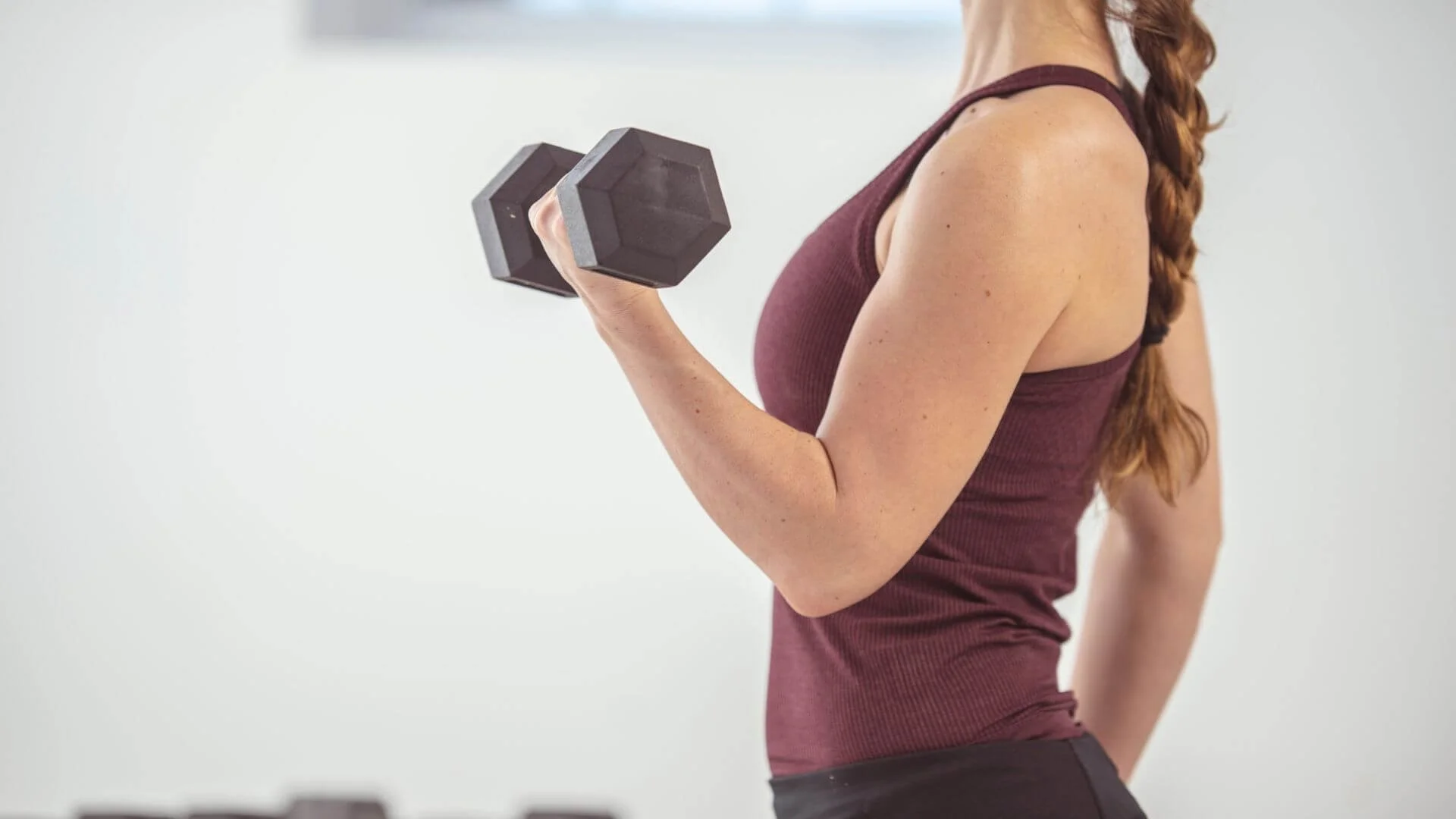
Let's say you're doing 10 dumbbell curls:
If you finish all 10 and feel like you could easily do 15 more, your weights may be too light.
If you can barely complete six repetitions without swinging your arms, they're probably too heavy.
If repetitions eight, nine, and ten require effort while your form stays controlled? You're likely in a good starting range.
The goal isn't to make every workout as exhausting as possible. It's to challenge your muscles enough to encourage progress. And remember, the right weight for you today may be different from what you lift six months from now.

How to Choose the Right Weight for Your Workout
You don't need to know your maximum lifting capacity to get started.
In fact, if you're new to strength training, we'd rather see you focus on learning the movements before worrying about lifting heavier.
Here's a simple approach.
Step 1: Start With a Lighter Weight
Choose a weight you're confident you can control for approximately 8–12 repetitions.
If you're learning a squat, you might begin with just your body weight. If you're practicing dumbbell shoulder presses, you might start with relatively light dumbbells.
Your first set is an opportunity to learn how the exercise feels. Pay attention to your balance, posture, range of motion, and control.
Step 2: Complete Your Repetitions
Perform your planned repetitions without rushing.
As you approach the end of your set, ask yourself:
Am I maintaining proper form?
Are the last few repetitions becoming challenging?
Could I do two or three more repetitions if needed?
Am I feeling the exercise in the intended muscles?
These questions tell you much more than the number on the weight.
Step 3: Adjust the Weight
Once you've completed your set, evaluate how it felt.
If you finished easily, consider increasing the weight slightly.
If you struggled to maintain control or couldn't complete your repetitions, reduce the weight.
If the final repetitions were challenging but controlled, you may have found an appropriate working weight.
Step 4: Track Your Progress
Write down the exercise, weight, and number of repetitions you completed.
For example, dumbbell chest press: 3 sets of 10 repetitions with 15-pound dumbbells.
Next time, you'll have a starting point instead of guessing.
At Peak Physique, tracking progress helps us decide when to challenge clients and when to make adjustments.
How Do I Know If I'm Lifting Too Heavy or Too Light?
One of the most useful strength training skills is learning to recognize when your weights need adjusting.
| Too Light | Just Right | Too Heavy |
|---|---|---|
| Every repetition feels easy | Final repetitions require effort | You can't complete the planned repetitions |
| You could perform many more repetitions | You could complete about 2–3 more | Your form breaks down |
| Little muscular challenge | Controlled movement throughout | You swing, jerk, or use momentum |
| You finish without much effort | You feel challenged but in control | You experience pain or lose control |
These are guidelines, not strict rules for every training program.
Experienced lifters may intentionally train closer to muscular failure, while beginners often benefit from leaving more repetitions in reserve. Never sacrifice proper technique just to lift a heavier weight.
How Much Weight Should I Lift for My Size?
Here's a question we hear often: How much should I lift for my weight?
You might assume that someone who weighs 200 pounds should automatically lift more than someone who weighs 140 pounds. But that's not necessarily true.
Your body weight and size don't tell the whole story.
Several factors influence how much weight you can comfortably and effectively lift:
Training experience: Someone who has trained consistently may lift more than someone just starting.
Muscle strength: Your current strength matters more than your weight alone.
Exercise selection: You can generally lift more during a squat than a lateral raise.
Movement technique: Proper form and coordination influence how much resistance you can control.
Previous injuries or limitations: Some movements may require modifications or lighter resistance.
Fitness goals: Someone training for muscular endurance may use different weights than someone focused on maximal strength.
So, if you're wondering, "How much weight should I lift for my size?" there's no universal chart that can give you the perfect answer.
Start with what your body can do today, not what someone else of a similar size can lift. We always remind our clients that your progress is yours. Don't compare it to the person lifting next to you.
How Much Weight Should I Lift Based on My Fitness Goals?
The amount of weight you choose also depends on what you're trying to accomplish. Different repetition ranges and resistance levels can emphasize different training adaptations.
If Your Goal Is to Build Strength
Training for maximal strength generally involves heavier weights and fewer repetitions.
Experienced lifters may perform approximately 1–6 repetitions per set using relatively heavy resistance.
However, beginners can build strength with moderate weights and higher repetition ranges while developing proper technique.
If Your Goal Is to Build Muscle
Muscle growth, also called hypertrophy, is often associated with approximately 6–12 repetitions per set.
For example, you might do three sets of 10 dumbbell chest presses with a weight that makes the final reps challenging. However, muscle growth can occur across a wider range of repetitions when the sets provide sufficient muscular challenge.
If Your Goal Is to Improve Muscular Endurance
Muscular endurance is your ability to repeatedly use your muscles without tiring quickly.
This type of training generally involves lighter resistance and higher repetitions, often 15 or more per set. It's useful for people who want to sustain repeated movements during exercise and everyday activities.
If Your Goal Is General Fitness
You don't need to choose just one repetition range.
A well-rounded strength training program can include different exercises, weights, and rep ranges to build strength, muscular endurance, and overall fitness.
That's why personalized programming matters.
We don't do cookie-cutter workouts at Peak Physique because your goals should determine your training.

Should Beginners Lift Heavy Weights?
If you're new to strength training, focus on learning proper form before lifting heavier weights.
Start with bodyweight exercises or lighter resistance to build coordination and confidence. As movements become easier, gradually increase the weight.
For example, you might progress from bodyweight squats to dumbbell goblet squats before trying heavier resistance.
There's no need to rush. Learning proper technique is progress, too!
When Should I Increase the Weight I'm Lifting?
As you get stronger, weights that once felt challenging may become easier. That's when progressive overload comes in, gradually increasing the demands on your muscles to continue building strength.
You may be ready to increase your weight when:
You consistently complete all your repetitions.
Your form remains controlled.
The final repetitions feel easier than before.
You could comfortably perform several more repetitions.
For example, if you've been doing dumbbell rows with 15-pound weights and they no longer feel challenging, you might try 20 pounds while maintaining proper form.
Remember, progress isn't always about lifting heavier. More repetitions, better control, and improved range of motion count, too!
Do Men and Women Need to Lift Different Weights?
Not necessarily! While average strength and muscle mass can differ, men and women benefit from the same strength training principles.
And ladies, don't avoid heavier weights because you're worried about getting bulky. Building substantial muscle takes time and consistent training.
Choose weights based on your abilities and goals, not your gender or age.
Whether you're 25, 45, or 65, you can adapt strength training to your fitness level and experience.
Why Working With a Personal Trainer (Like Peak Physique in Troy, MI) Can Help
Choosing the right weights is easier when someone can watch your technique and help you understand your progress.
At Peak Physique, our trainers don't simply hand you dumbbells and count repetitions.
We help you learn what exercises should feel like, choose the right resistance, and know when you're ready for a new challenge.
Maybe you're nervous about lifting weights for the first time. Maybe you've been using the same dumbbells for years. Or maybe you want to build strength but aren't sure how to progress.
That's where personalized training makes a difference.
We want you to feel confident in what you're doing, understand why you're doing it, and recognize how far you've come.
Get Stronger With Personal Training in Troy, MI
So, how much weight should you lift? Enough to challenge yourself, but not so much that you sacrifice proper form.
And remember, getting stronger isn't about lifting the most weight in the room. It's about making progress from where you started.
At Peak Physique in Troy, Michigan, we help people of all fitness levels build strength through personalized workouts, expert guidance, and a supportive environment.
Whether you're picking up dumbbells for the first time or looking to challenge yourself in new ways, we're here to help.
Schedule today and get your first workout free with your consultation and discover what you're capable of!
Frequently Asked Questions About How Much Weight to Lift
How Much Weight Should I Lift as a Beginner?
Start with a weight you can control for approximately 8–12 repetitions. The final few should feel challenging, but you should still be able to maintain proper form.
Should I Lift Heavy Weights or Light Weights?
Both can be effective. Heavier weights with fewer repetitions generally emphasize maximal strength, while lighter weights with higher repetitions emphasize muscular endurance. Your goals determine the best approach.
How Do I Know When to Increase My Weights?
Consider increasing your weights when you can consistently complete your planned repetitions with proper form and the final repetitions no longer feel challenging.
Is It Better to Lift More Weight or Do More Repetitions?
Neither is universally better. Heavier weights and lower repetitions can emphasize strength, while lighter weights and higher repetitions can emphasize endurance. Both approaches can support muscle growth.
Should I Lift Until I Can't Do Another Rep?
Not necessarily. Beginners can benefit from finishing sets with 2 or 3 reps left in the tank. You don't need to reach absolute muscular failure to make progress.
How Much Weight Should I Lift for My Age?
There's no universal lifting target based on age. Your appropriate weight depends on your strength, experience, health, goals, and ability to perform each exercise with control.